 |
|
|
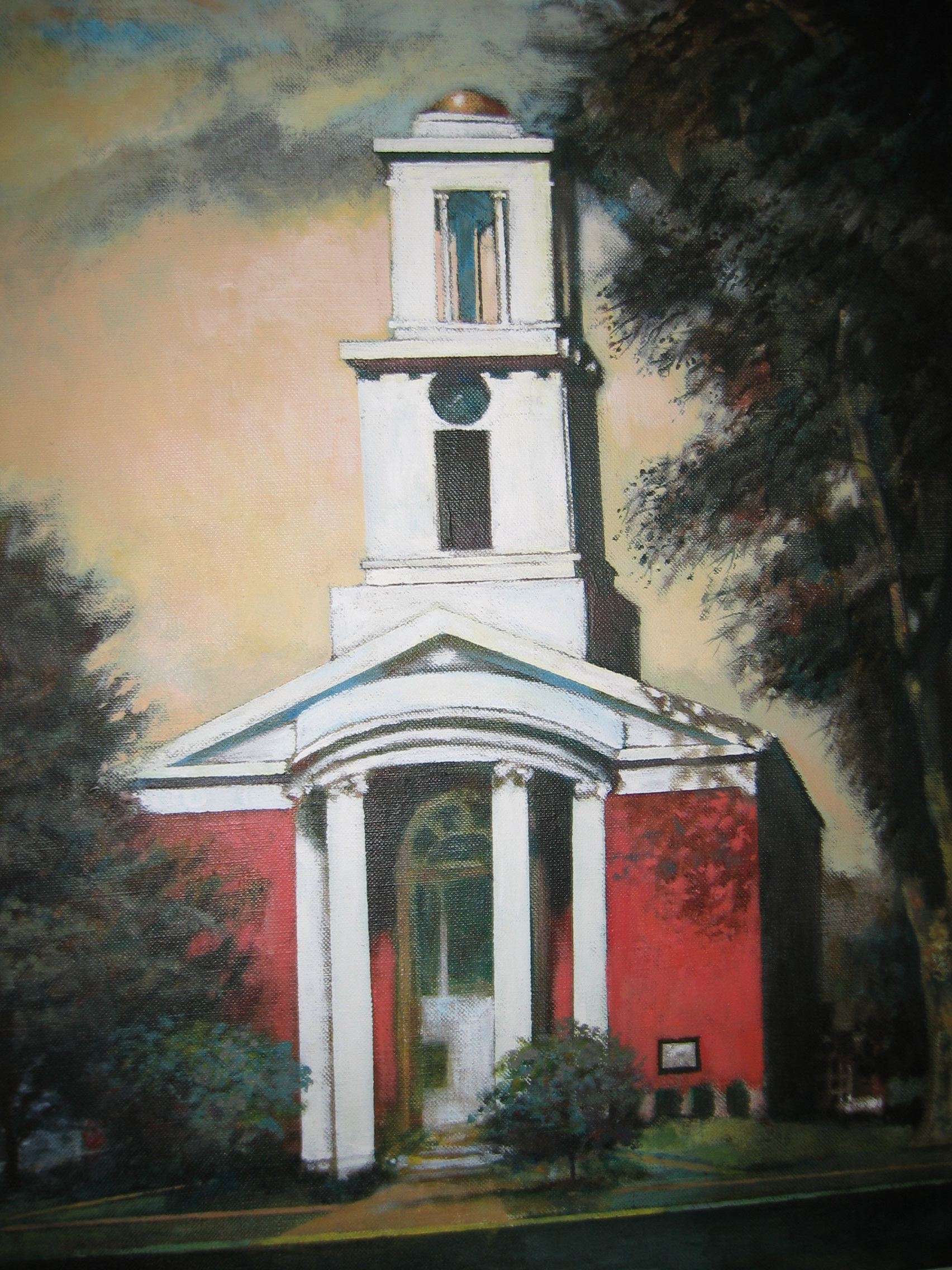
First Baptist Church
of Hamilton, New York
Founded in 1796, First Baptist is an American Baptist church with an ecumenical congregation. First is the "Mother Church" of Colgate University.
artist: James Loveless

MusicMembers of the Music Committee (2011) include: Peter Lawrence, Joan Prindle, Kirsten Weyter, Cindy Martin (ex officio) and Chris Warren (ex officio). |
 |
|
 |
(Photo courtesy of Rob Howard.) |
|
Report on the Organ Christopher C. Warren On October 10th, our organ sounded forth in a brilliant recital by an extraordinary player, Glenn Kime, of May Memorial Unitarian, Syracuse, and Colgate University. Mr. Kime delighted his audience with a variety of compositions exemplifying different styles and posing numerous interpretational challenges. A new stop, a Cornopean, was installed by the Kerner & Merchant firm shortly before the recital. It was exciting to hear it publicly for the first time, as the organist demonstrated its assertive, distinctive tonality in a piece specially chosen for this purpose. While this concert was undoubtedly the highlight of the year, it is important to emphasize that once again, throughout the year, the organ served its purpose well in its most obvious role -- supporting Sunday worship services. It also played a prominent role in two special events: the July 4th celebration and the installation service for our new pastor. Through preludes, offertories, postludes and, most importantly, accompanying hymns, the pipe organ creates a favorable atmosphere for the worship experience, one that no other instrument (or instruments) can provide. Excellent maintenance and other service as needed are crucial, of course, and for this we thank K&M. We also value their opinions and advice on measures for further development/improvement, as may be beneficial. Let us briefly turn back the clock -- 156 years! -- to 1855, when the first pipe organ was purchased for the 13-year-old sanctuary. Regrettably, church records contain almost no relevant information, but a small amount does appear (including the 1855 installation date) in a recently published book about the Andrews Organ Company, first operating out of Waterville and then Utica. They built several hundred organs, including many in the central NY area. Their records state that the 2-manual organ for First Baptist cost $1,200, and that in 1861, something further was done -- perhaps an addition. One wishes that a stoplist, detailing the organ’s resources, were provided, but alas, there is none. The Andrews organ served up until the Estey Company built the present one, now very different and larger than it was over a century ago in 1905. The church asked Estey if they could use anything from the Andrews instrument in the new organ; the answer was negative. (Quite often, some of the pipework from an existing organ can be incorporated into a new one.) It is interesting to consider the $2,500 difference in the prices of these two organs, separated by 50 years. Certainly we may conclude that the Estey (costing $3,700) contained well over twice the amount of stops. Accordingly, it was far more suitable and effective for our sanctuary than its predecessor. Around the turn of the last century the congregation was growing rapidly, undoubtedly a factor in the decision to construct a sizeable addition for the building and to purchase a much larger organ, the latter made possible by a gift from the Pierce family. Our organ's size has increased significantly since the 1905 installation, especially with the marvelous addition of the antiphonal division (rear balcony), built by K&M in 2004. At this point, adding a third manual would be highly advantageous for optimum organ performance. In fact, this was discussed with K&M as early as 2000-01, when major refurbishing took place. Now, with over 2,200 pipes -- 37 ranks -- we have a large 2-manual instrument. Many of comparable size (and even smaller) are controlled by three manuals. Such a change, while costly to be sure, would be entirely justifiable here at First Baptist, according to K&M. Definitely food for thought. Good news for the future! Another public organ recital is scheduled for next October, on the ninth, a Sunday, in the afternoon. Dr. Kola Owolabi, Assistant Professor of Music and University Organist, Hendricks Chapel, Syracuse University, will be our guest. This accomplished, gifted musician is widely recognized for his technical prowess and interpretive skills. Please mark your calendars -- reserve this date! 2009 ReportThe Estey pipe organ, Opus 217, was built in 1905 and installed in December of that year, replacing an Andrews instrument dating from 1855. Through the years, ongoing modernization as well as several enlargements (pipes added) have expanded its capabilities appreciably, increasing the degree of tonal versatility as well as “player friendliness.” This organ admirably fulfills the requirements of worship services and other occasions, including recitals. Over the last few decades, the Kernes & Merchant firm (East Syracuse) have cared for the organ. Major renovation was accomplished in 2001, and in 2004 they installed the six-rank antiphonal division, located in the rear balcony, along with a fine 25-node set of chimes. The most recent addition: 61 chorus-reed pipes for the great division. September, 2010. The two-manual organ has 37 ranks of pipes – the total number of speaking pipes is 2,201. An electronic 12-node extension provides valuable 32’ pitch for the pedal division. The Pianos in 2009: Hello DolliesDollies? Why yes, indeed. See them supporting our two grand pianos - the Steinway in the sanctuary and the Baldwin in Fellowship Hall (formerly in the Clark Room, as part of the late Lois Lee's gift). Grand pianos (and uprights, too) are heavy and awkward, and not easily moved on the small casters that come with them. In a private home it may rarely be necessary to move a piano. However, the situation is different in public multi-functional rooms such as our sanctuary and Fellowship Hall. For a grand piano, a dolly helps solve the mobility problem; although hardly a thing of beauty, it is practical. The piano sets on this metal device, positioned under the three legs. Its fairly large wheels will harm neither a rug nor a bare floor, and will allow for relatively easy movement. The Steinway upstairs was fitted with a dolly after it was rebuilt many years ago and brought into the sanctuary. (For several decades it had been downstairs where, unfortunately, it deteriorated.) Our other grand, the Baldwin, was dolly-less until recently, after the move to Fellowship Hall. The black finish of the new Baldwin dolly gives it the best possible appearance. Taking note of this, we decided to paint the Steinway dolly black, far more appealing than the former aluminum color. The upstairs dolly now matches the piano case - a real improvement since the Steinway, right in front of the pulpit apron, is very visible. Its overall black color harmonizes well with the rich red of the new carpeting.Several measures have been taken to enhance the Baldwin grand. First was the thorough tuning, always necessary after a move. Then, a "Dampp-Chaser" was installed. This simple electrical device has long served the Steinway. The same protection will benefit the Baldwin. A small unit, mounted under the piano, automatically supplies either heat or humidity (a small water tank must be kept filled) as required in order to maintain optimum conditions for the piano's woodwork, leather and felt, integral to its sound. The Steinway is equipped with a heavy cloth cover that can be placed over it to protect the exterior and maximize the heat/humidity conditions within. We purchased a similar cover for the Baldwin. We also installed a locking device for the keyboard cover, to prevent misuse. Last, we purchased a (so-called) artist's bench for the Baldwin, somewhat smaller than the conventional bench and far more versatile, since its height is adjustable. Its brown finish complements that of the piano case. The new bench is a "one-seater," whereas the duet bench upstairs seats two. That bench can be brought downstairs if duets are performed on the Baldwin. In addition to the Baldwin grand, we have a Baldwin upright. For many years in Fellowship Hall, it is presently located upstairs in the choir room. The Baldwin replaces the piano donated several years ago by Lois Rainsford; we gave that piano to the Randallsville church. Since there was much piano-related activity in '08, it is appropriate to present the details here. Usually the annual keyboard report centers on the pipe organ, which, after all, occupies the prime position in the musical context of this church. The organ functioned well in '08, for the most part. Toward the close of the year, strange things were happening because of an electrical problem, now apparently solved. Everyone should be assured that the piano situation is favorable and promising for the future. Our Steinway in the sanctuary is most frequently used, since it accompanies the choir. Fellowship Hall’s Baldwin is capable of serving a variety of needs, as they arise. And the choir room Baldwin upright is essential for pre-service warmup sessions. Four fine keyboard instruments enrich the musical experience at First Baptist: something to celebrate! The Organ in 2007During the past year the organ has continued to serve our needs well, thanks to Kerner & Merchant Pipe Organ Builders. They attend to maintenance and tuning, as well as special needs that occasionally arise. In the summer, K&M replaced the Peterson chimes, installed a few years ago, with new ones, manufactured by the Deagan firm. The new chimes, with a five-level volume control like their predecessors, are superior tonally. Another advantage is the appearance of the new chimes, whose 25 brass-polished tubes add a welcome visual highlight to their balcony location. Two improvements were made to the console that increase its degree of “user-friendliness.” The two rows of tilting tablets above the manuals, which control mostly stops but also the inter- and intramanual couplers, were replaced. The new tablets are arranged in a more practical manner. In addition to nomenclature, they now bear numbers, making it far easier for the organist to jot down information when working out registration (selecting the appropriate stops) for a piece and recording such information for immediate (and possibly future) use. These tablets—86 plus five blanks—may be depressed and released manually. However, when playing, it is usually far more convenient to rely on the combination action system to do this. Underneath the manuals are rows of buttons called combination pistons. A finger push engages them. Above the pedalbard are some similar devices—toe studs—operated by the feet. It is a simple task to program the combination action system; instantaneous changes in registration may then be made at any time, by a free finger or foot. A second improvement is a new display screen, located just above the top (swell) manual. This replaces the former screen, which was smaller, dimmer, and rather difficult to read. This screen indicates which of many functions is currently in use, for example, transposing, recording, or playing back, to name three. But the most crucial information concerns the memory level that the organist has selected. These levels govern the entire combination action system. There are 100 in all, providing a tremendous degree of flexibility as far as registration is concerned. History of the organ at FBC:In 1904, discussion leading to a replacement of the first pipe organ began in conjunction with plans to refurbish the sanctuary at First Baptist (after more than 60 years of use) and to construct a much needed addition to the building. The original Andrews organ was antiquated. Eventually the church contracted with the Estey Organ Company of Brattleboro Vermont. The Estey instrument, installed in December 1905, was first heard in early January 1906, at the time of celebration for the completion of sanctuary renovation and the sizable addition to the back of the building. Understandably, the organ has undergone numerous changes over the past century, thanks to modernization efforts in line with advancing technology. Virtually unchanged, however, is the imposing Greek Revival case with its 63 display pipes: the visual centerpiece of the room. Most of the original functional pipework survives, although there have been a few replacements as well as several additions representing various tonal colors. Deserving of special mention is the antiphonal division in the rear balcony, built in 2004 by the Kerner & Merchant firm. Its six distinctive ranks of pipes splendidly increase the organ’s musical capacity and benefit from the sanctuary’s favorable acoustic conditions. The recently purchased zimbelstern is a delight! The organ presently comprises 1,993 pipes (34 ranks) controlled by 84 stops and distributed over two manuals and a pedalboard. Additionally, 12 electronically produced tones provide a deep bass pitch not currently available on any other area pipe organs. Another resource is the 25-note set of chimes, located in the rear balcony. This up-to-date instrument plays an integral role in all types of services, and is suitable for concert use as well. We encourage visitors to come and experience the inspiring voices that constantly enrich the worship experience for both regular parishioners and guests. On August 27, 2006, a new tonal accessory to the organ was introduced - a zimbelstern. The zimbelstern is located on a platform just behind the largest pipe in the center of the facade and is operated electrically and controlled by a stop tablet on the oran console. The device is 10" square, 12" tall and has baffles on two sides that help project the sound outward into the room.
Nine high-pitched variously shaped brass bells, arranged in a circle are struck by a rotating mechanism in the center. When in use, they provide a distinctive complement to organ sound either by itself or as accompaniment. The word zimbelstern means "cymbal-star." It is comparable to the popular Christmas holiday table decoration where heat from candles turns a "windmill" that strikes small cymbals. Like the chimes, the zimbelstern adds significantly to the tonal palette of the organ. It increases the organ's expressive capacity, benefiting both the worship and musical experience offered at First Baptist. |
||
Senior and Junior ChoirsChoir Rehearsals at 8:45 a.m. Sundays (September through June) Director: Lucinda T. Martin The Senior Choir currently has fifteen members. I am very pleased to report that three of those members are Colgate students and two are high school students! Members of the choir practice every Sunday from 8:45-9:30 a.m. Extra rehearsals are added in the evenings before the Christmas and Easter services. The choir performs at least three, sometimes four times a month, from September until June. During the year the choir performed three and four-part literature in a variety of styles. Three area high school musicians joined us by accompanying the choir on their instruments. We have an exceptional group of dedicated musicians who remain enthusiastic at all times. I am extremely fortunate to have the opportunity to work with such a wonderful group. Many thanks to the CWF, and Ellen Mordus and her quilt group for contributing towards the cost of music this year. Thanks also to Lillian Townsend who helps by organizing the music, and a special thank you to Chris Warren for accompanying our rehearsals and performances!The Junior Choir sings once a month, usually on the third Sunday of the month. It is comprised of five children ages 3-9. The Junior Choir rehearses during the twenty minutes before Sunday School. |
||

First Baptist Church
27 Broad Street
PO Box 73
Hamilton, New York 13346
315-824-2780